This one arrived sideways. A post by Ben Alexander about rugby coaching sent me back to a line from Desmond Tutu:
Desmond Tutu
“There comes a point where we need to stop just pulling people out of the river. We need to go upstream and find out why they’re falling in.”
Ben was talking about coaching. Tutu was talking about justice. I couldn’t stop thinking about governance — which is a fair sign that the idea travels.
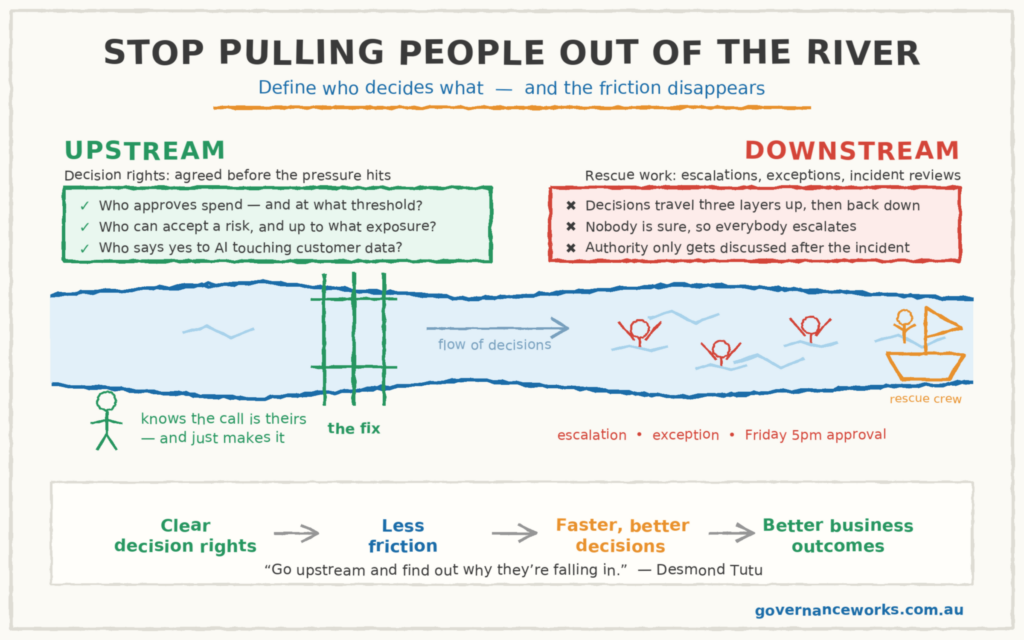
Because it’s as good a description of governance as I’ve heard. Most organisations are exceptional at rescue work. Escalation meetings, exception approvals, the urgent Friday afternoon decision that needed to happen on Tuesday. Everyone’s wet, everyone’s tired, and nobody has asked why so many people keep ending up in the water.
Go upstream and you usually find the same thing: nobody knows who is allowed to decide what.
Friction is a governance failure, not a personality problem
When a decision stalls, the instinct is to blame the people. The team is too cautious. Legal is a handbrake. The exec is a bottleneck. Occasionally that’s true. Far more often, the people involved are behaving perfectly rationally in the face of genuine ambiguity.
If you don’t know whether a decision is yours, you have two options. Escalate it, which is slow. Or make it and hope, which is risky. Most sensible professionals escalate. Do that a few hundred times a year across an organisation and you have manufactured your own bottleneck — then hired a consultant to explain why you’re slow.
The friction isn’t caused by difficult people. It’s caused by an undefined decision.
What decision rights actually are
Decision rights are the upstream fix: a documented answer to who can decide what, within what limits, and who must be consulted or informed along the way.
Not an org chart. An org chart tells you who reports to whom, which is a different question entirely and answers almost nothing useful in the moment. Decision rights are specific and boring in the best possible way:
- Who can approve spend, and at what thresholds?
- Who can accept a risk, and up to what level of exposure?
- Who can approve a new AI tool being used on customer data — and who only needs to be told?
- Who signs off on an exception to policy, and for how long?
- What actually has to reach the board, as opposed to what people habitually send there?
That last one is worth sitting with. A surprising amount of board time is consumed by decisions the board never asked to make and isn’t best placed to make, purely because nobody ever defined the alternative.
AI has made this urgent
Every organisation I speak to is grappling with this right now, because AI has taken a longstanding vagueness and turned it into an immediate exposure.
Who decides whether a team can put client data into a chatbot? Who decides that a model’s output is good enough to send to a customer without a human reading it? Who decides an AI system has drifted far enough to be switched off? In most organisations, the honest answer is that nobody decided — someone simply did it, and the question of authority only surfaces afterwards, usually in an incident review.
That’s the river again. You can staff up on rescue swimmers, or you can define the decision.
Less friction, better business
The commercial case here is straightforward, and it isn’t primarily about risk.
Defined decision rights make organisations faster. Decisions get made at the level where the knowledge actually sits, rather than travelling up three layers and back down. They make people bolder, because acting within a clear mandate is not a career risk. They make accountability real, because when something goes wrong you can point to who was authorised to decide, rather than running an archaeology project. And they make delegation possible, which is the only way a growing business ever scales past the capacity of its founders.
Less friction leads to faster, better business. Faster, better business leads to better outcomes — for the organisation, its customers, and the people who work there.
Where to start
You don’t need a transformation program. Start with your last ten escalations and ask a single question of each: did this genuinely need to come here, or did it arrive because nobody knew where else to send it?
The answers will tell you exactly where your decision rights are missing. That’s your upstream.
If you’d like help mapping decision rights across your organisation — particularly for AI and technology decisions, where the ambiguity is sharpest — get in touch with Governance Works. It’s a short piece of work with a disproportionate payoff.