AI Strategy

Decide what AI is actually for

Most AI strategies are a list of tools. 

Yours should be a list of decisions.

If you’re being told “We need AI” and your response is “What for?” then this is for you and whoever is asking for AI.

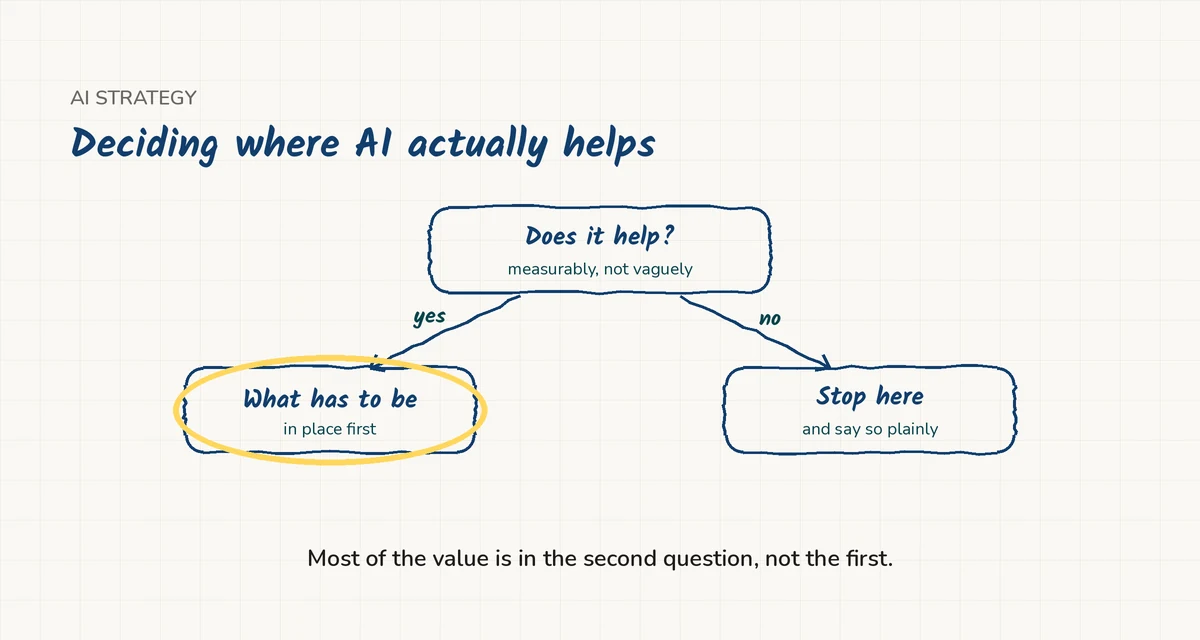
A decision tree for assessing a candidate AI use, and what has to be in place before it proceeds Book a conversation

You are being asked for a position on AI

Your board wants to know what you are doing about AI. Your team has already started using it, with or without permission. A vendor has told you their product now has AI in it, and you cannot tell whether that is a feature or a liability.

Meanwhile the honest answer, that some of this will be useful and some of it will not, is hard to say in a board paper.

An AI strategy is not a technology plan. It is a set of decisions about where you will use AI, where you will not, what you need in place before you do, and how you will know if it is working.

What you walk away with

An honest opportunity map

Where AI would genuinely help your organisation, ranked by value and effort.

Just as importantly, where it would not, so you can stop being sold it.

Your actual AI inventory

What your people and your vendors are already running.

This is almost always more than leadership expects, and it is the thing auditors ask about first.

A position you can take to the board

A short, plain-English strategy document your directors can read in ten minutes and make decisions from. Not a technology roadmap.

The gap list

What you need in place before the first real deployment: policy, oversight, skills, data readiness, contracts. In order, with effort estimates.

A first move worth making

One use case scoped tightly enough to actually start, chosen because it will teach you something whether or not it succeeds.

How it works

  • Understand the business first. Half a day with you and your leadership team. What are you trying to achieve, what constrains you, where does the pressure come from.
    Find what is already running. Interviews, a short survey, a look at your vendor contracts. Shadow AI use is normal, not a failure, and you cannot govern what you have not found.
    Map opportunity against readiness. Not every good idea is a good idea yet. This step is where most of the value is, because it stops you buying something you cannot support.
  • Test the shortlist. Two or three candidate use cases, examined properly: what would it cost, what could go wrong, what would you need to be true.
  • Write it down. A strategy document, a gap list, and a first move. Short enough to be read, specific enough to act on.
  • Present it. If it helps, I will take it to your board or executive myself and answer the hard questions.

Who this suits

It is probably not for you if you already know exactly what you want to build and just need it built. That is a delivery problem, not a strategy one, and you would be paying me to agree with you.

Useful next

Most people who start here go on to AI Governance or ISO 42001. If you want to see how I think before committing, the AI Governance Assessment Pack covers a lot of the same ground.

Most people who start here go on to AI Governance or ISO 42001

Not sure where to start?

Tell me what you're facing. You'll get a straight answer on whether this is the right piece of work, and what it would involve.

Book a conversation