If you want to speed up AI adoption, build the governance in alongside it, from day one. Organisations that stand up the structure at the same time as their AI use move faster, not slower. The ones that treat governance as a later phase, something to circle back to once adoption is underway, are the ones that stall.
That’s the opposite of how most boardrooms talk about it. The common assumption is that governance is the thing that slows deployments down; put in the controls, the story goes, and you trade speed for safety. So organisations either skip governance to move fast, or bolt it on late and watch it become the reason nothing ships on schedule.
Both outcomes come from the same misdiagnosis. The friction people blame on governance is very rarely caused by governance. It’s caused by ambiguity, governance’s absence, not its presence.
The friction was always there. Governance just gets blamed for it
Watch what actually happens inside a team that’s “waiting on governance” and it rarely looks like a control blocking a decision. It looks like a number getting revalidated for the third time because nobody is sure it’s trusted. It looks like an executive asking for one more cut of the data before they’ll sign off. It looks like an exception that should take ten minutes turning into a two-week escalation chain, because nobody quite owns the call.
None of that is a control working as intended. It’s the absence of one. When it’s unclear what data can be relied on, who is actually authorised to decide, and where the real guardrails sit, every decision starts from zero. Teams don’t slow down because the rules are strict. They slow down because there aren’t any rules to move against, so they default to asking, checking, and escalating everything.
That’s not caution. It’s friction deferred, and it shows up later as missed deadlines, stalled pilots, and a leadership team that starts to believe AI projects are inherently slow.
What governance actually buys you: speed
Good governance replaces that ambiguity with a small number of clear answers, defined in advance: what data and models are approved for use, who owns which category of decision, where the guardrails sit, and exactly when something needs to be escalated rather than decided on the spot.
Once those answers exist and are known across the business, most decisions stop needing a conversation at all. People aren’t waiting for permission; they’re checking against a structure they already understand and trust. That’s the entire mechanism. Governance done right doesn’t add a gate to the process. It removes the hundred small, informal gates that ambiguity was creating anyway.
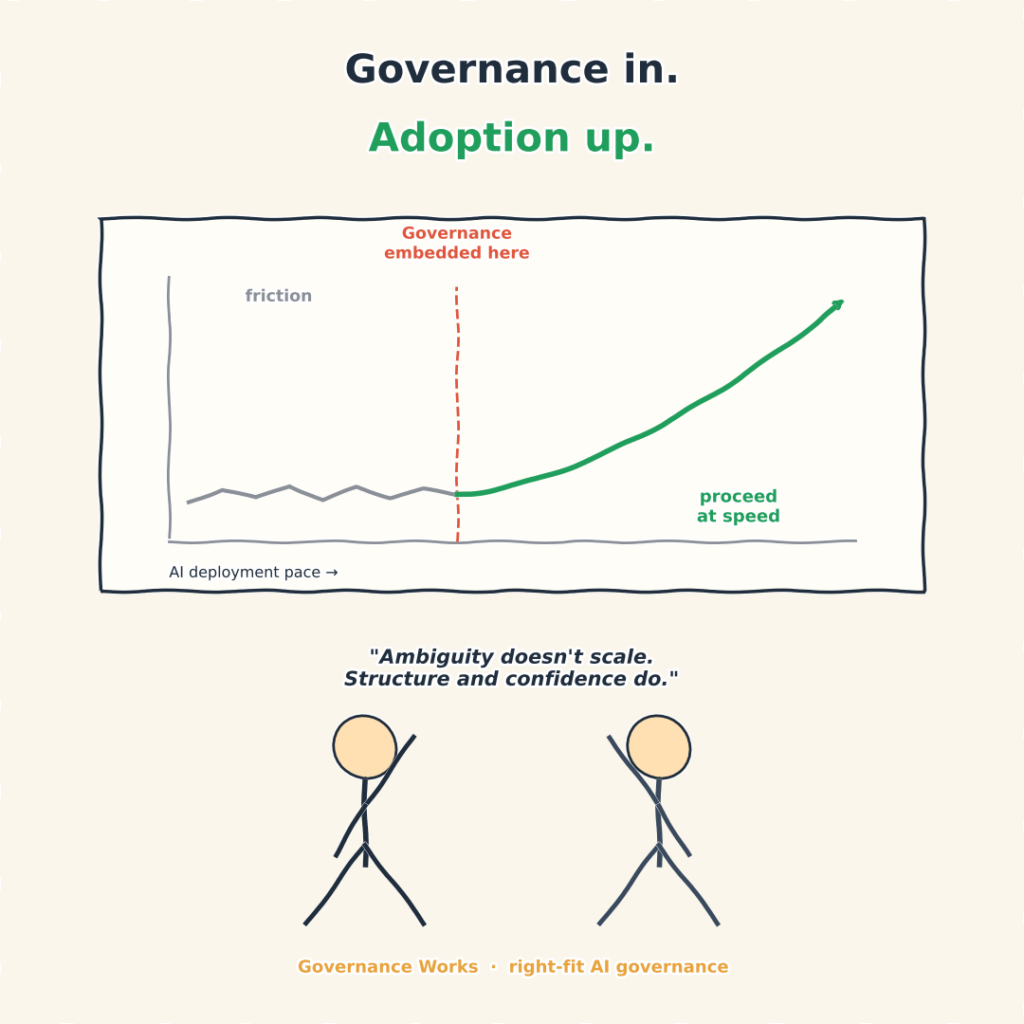
“Ambiguity doesn’t scale, but structure and confidence do.”
This is why the organisations that get AI governance right don’t describe it as a brake. They describe deployments that, once the structure is embedded, proceed at speed, because the questions that used to stall a project have already been answered before the project starts.
Right-fit, not heavyweight
None of this requires a large governance function, a six-month build, or a program sized for an organisation ten times your size. That’s the version of governance that actually does slow things down, because it’s disproportionate to the risk it’s managing, and everyone learns to route around it.
The governance that speeds deployments up is scoped to the organisation using it: a short, clear set of ownership rules, a small number of genuinely necessary controls, and escalation paths that only trigger when they need to. Built this way, it can usually be stood up in weeks, by a small team, without an enterprise price tag attached. The goal isn’t maximum governance. It’s the minimum structure that removes ambiguity from the decisions your teams make every day, and it should flex as your use of AI matures rather than being built once for a size you haven’t grown into.
Where to start
If AI deployments in your organisation are stalling, it’s worth asking whether the real cause is a control that’s genuinely too strict, or a decision nobody has clearly owned. Most of the time, it’s the second one, and it’s a much cheaper problem to fix.
That’s where Governance Works can help. We build right-fit AI governance structures, scoped to your organisation’s size and risk profile, so your teams stop re-checking and start moving. If ambiguity is what’s slowing your AI program down, get in touch and let’s talk about what structure would actually buy you.